
When marketing pesticides in the U.S., every statement you make about a product's effectiveness, safety, or features is considered a claim. To comply with federal regulations, these claims must be supported by substantiation - scientific proof that exists before the claim is made public. Both the EPA and FTC oversee this process, ensuring claims are truthful and backed by evidence.
Key Points:
- Claims: Statements like "kills 99.9% of bacteria" or "safe for pets" must align with EPA-approved labels.
- Substantiation: Requires lab studies, field trials, or expert data to prove claims are accurate.
- Regulatory Risks: Misleading claims can lead to fines, product recalls, or reputational harm.
- Best Practice: Maintain a clear review process, document evidence, and ensure claims are consistent across all marketing materials.
Understanding the difference between claims and substantiation helps avoid legal issues and builds customer trust. Always verify claims with evidence before publishing to stay compliant with EPA and FTC requirements.
Pesticide devices: how to navigate US regulations and substantiate claims
Understanding Pesticide Claims
When you advertise that a product can prevent, destroy, repel, or mitigate pests, you’re making what’s known as a pesticidal claim. This applies to pests like insects, rodents, weeds, bacteria, and viruses. Even something as simple as naming a product "Roach Guard 24/7" can fall under regulation by the Federal Insecticide, Fungicide, and Rodenticide Act (FIFRA) because it implies continuous pest protection - even if that wasn’t the intention. Using pesticidal language in your marketing means your product is likely regulated as a pesticide, requiring compliance with EPA registration and labeling rules. Let’s dive into the types of claims that demand careful attention and evidence.
3 Main Types of Claims: Efficacy, Safety, and Environmental
Pesticide advertising is scrutinized in three main areas: efficacy, safety, and environmental claims.
-
Efficacy claims describe how effectively your product works. Statements like "kills roaches within 24 hours", "controls ants for up to 90 days", or "eliminates 99.9% of household bacteria" are common examples. These claims must align with the specific pests, conditions, and performance data outlined in your EPA-approved label. Over-the-top phrases like "kills all pests instantly" won’t pass regulatory review unless backed by solid evidence.
-
Safety claims focus on potential risks to people, pets, or property. Phrases like "low odor" or "reduced spray drift" are acceptable when tied to EPA-approved labels. However, unqualified terms such as "child-safe", "pet-safe", or "non-toxic when used as directed" are problematic. Regulators flag these as misleading unless they are carefully worded (e.g., "safe when used according to label directions") because all pesticides carry some level of risk.
-
Environmental claims relate to a product’s impact on the environment or its chemical composition. Examples include "phosphate-free", "bleach-free", or "DEET-free". The EPA allows factual "ingredient absence" claims, like "phosphate-free formula", but broad terms like "eco-friendly" or "safe for the planet" may be seen as greenwashing unless properly substantiated.
Express Claims vs. Implied Claims
-
Express claims are direct and explicit, such as "kills on contact", "prevents termite damage", or "eliminates bed bugs in one treatment". These statements are easy for regulators to spot in advertising and must match the product’s registered uses and supporting data.
-
Implied claims are more subtle, arising from the overall context of your advertising. This includes words, images, graphics, or even product names. For example, phrases like "hospital-grade" or visuals showing pests dying instantly can imply superior efficacy, while terms like "safe for your family" or "gentle, plant-based protection" suggest reduced risks compared to conventional products. Regulators assess the overall impression of an ad, so everything from imagery to taglines needs careful review.
Common Mistakes in Pesticide Claims
Pest control companies often stumble over risky language. Absolute terms like "chemical-free" or "non-toxic" are misleading because all pesticides carry some level of risk and must include precautionary statements. In Texas, for instance, terms like "safe", "harmless", and "organic" are flagged as misleading unless accompanied by proper context or evidence.
Another frequent error is making unregistered or off-label claims. For example, advertising a disinfectant meant for hard surfaces as suitable for air disinfection goes beyond what’s allowed by the EPA-approved label. Similarly, implying government endorsement with phrases like "EPA-approved safe" or "recommended by the U.S. government" violates FIFRA rules. Claims of superiority, like "safer than traditional sprays" or "works better than leading brands", also require strong evidence to avoid being labeled as false or misleading. Missteps like these can lead to regulatory actions, including stop-sale orders or fines. To stay compliant, it’s essential to ensure your claims are backed by solid data and meet regulatory standards.
Understanding Substantiation Requirements
Substantiation isn’t just a legal formality - it’s a safeguard for both consumers and your business. In the U.S., you’re required to have solid evidence backing every claim you make in your advertising, no matter the platform. This applies to statements about your product’s effectiveness, safety, or environmental impact. Both the Federal Trade Commission (FTC) and the Environmental Protection Agency (EPA) demand that you have a reasonable basis for these claims. And here’s the kicker: you can’t wait until after making a claim to gather the evidence - it has to be ready beforehand. Let’s dive into how the FTC defines its evidence standards and the types of proof you’ll need.
The FTC's Evidence Standard
The FTC sets a high bar for claims related to health, safety, and performance. What they expect is scientific evidence - objective, reliable, and generated by qualified experts using widely accepted methods. The quality, quantity, and methodology of the evidence must directly support your claim. For instance, if you say your product "eliminates 99.9% of mosquitoes for up to 30 days", you’d need rigorous studies that test this exact scenario under realistic conditions.
Health or safety claims, like "safe for kids and pets" or "non-toxic", demand even more stringent proof. This often includes toxicology studies and risk assessments to back up those statements. The bottom line? The type of evidence you need depends entirely on the claim you’re making.
Types of Evidence for Substantiation
The kind of evidence required hinges on what you’re claiming. Here’s a breakdown:
- Efficacy Claims: These require controlled lab tests using standardized protocols. For example, tests might measure kill rates or how quickly pests are knocked down. Field trials are also critical for claims about long-term or residual effects, as they show how the product performs in real-world conditions.
- Safety and Environmental Claims: These need toxicology studies that focus on acute and chronic toxicity, irritation, and sensitization. Environmental data is also key - covering areas like bioaccumulation, persistence, and impacts on aquatic life, pollinators, and soil.
- Comparative Claims: If you’re saying your product "works better than leading brands", you’ll need comparative studies supported by strong statistical analysis.
It’s also critical that all evidence aligns with the EPA-approved label. Any mismatch could make your claims misleading or outright false.
When Evidence Must Exist and How to Document It
Here’s a non-negotiable rule: you must have substantiating evidence before any claim goes live - whether it’s on your website, in print, or part of a TV ad. For example, Texas pest control regulations explicitly prohibit advertising claims that lack evidence at the time they’re made. If you advertise first and gather proof later, regulators could label your product as misbranded, leading to stop-sale orders or even civil and criminal penalties.
To ensure compliance, maintain a substantiation file for every claim. This file should include:
- Full study reports (not just summaries)
- Detailed testing protocols and methods showing your evidence meets the required standards
- EPA-approved labels and registration documents
- Internal claim matrices that link marketing statements to their supporting data
It’s also wise to keep version histories of your labels and marketing materials. This helps demonstrate that claims are updated as new data or regulatory guidelines become available. With an organized system like this, your marketing, legal, and compliance teams can confidently ensure that every claim is backed by solid evidence before it’s published. For added support, consider working with specialized partners like Pest Control Content Marketing by Content Amplified (https://contentamplified.io), who can help verify that your messaging aligns with regulatory standards.
sbb-itb-bfd1c41
Claims vs. Substantiation: Main Differences
@figure 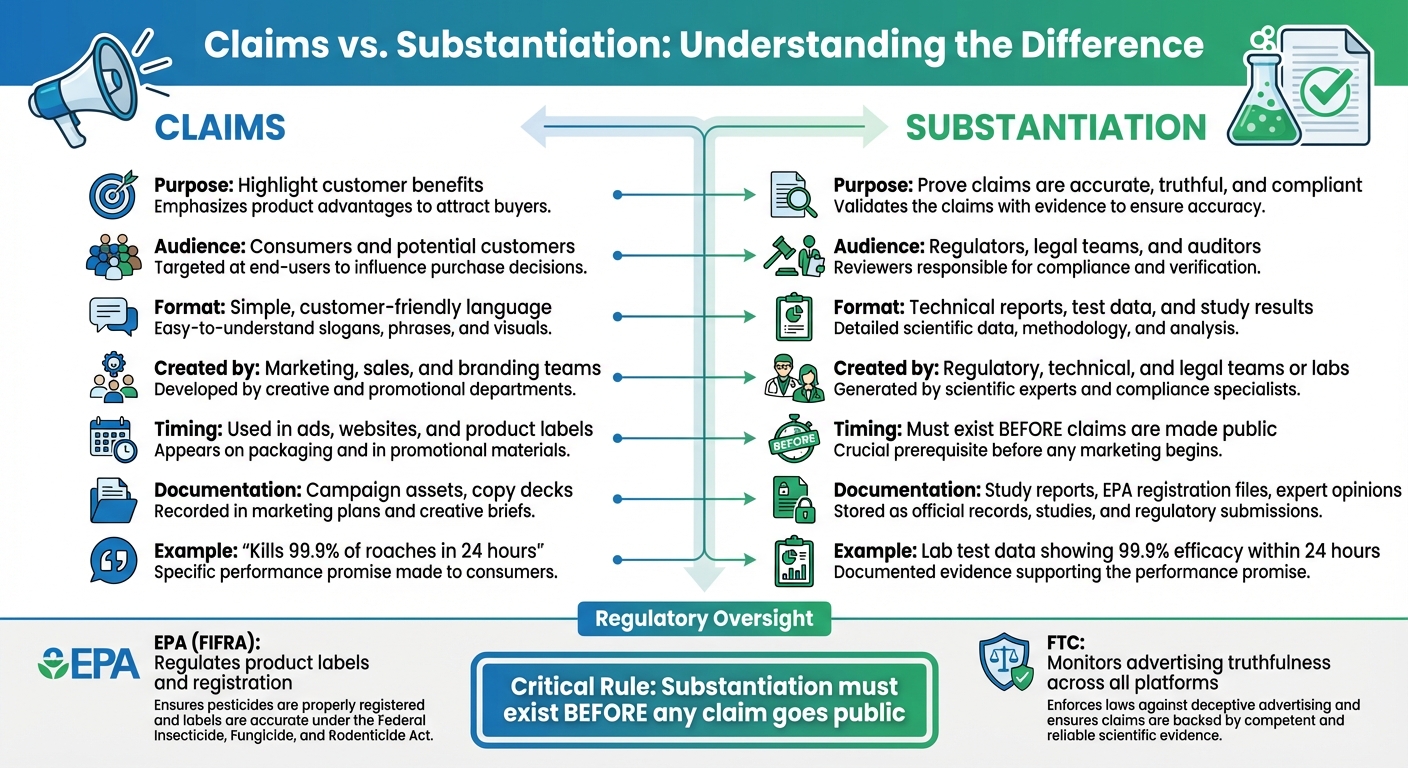 {Pesticide Claims vs Substantiation: Key Differences and Requirements}
Side-by-Side Comparison
Claims are all about showcasing benefits to customers, while substantiation provides the technical evidence that backs those claims and ensures they meet regulatory standards. Think of claims as the promises you make on websites, ads, or product labels - like "kills 99.9% of roaches in 24 hours" or "eco-friendly mosquito control". Substantiation, on the other hand, is the behind-the-scenes proof - studies, test data, field trials, or expert reports - that validates those promises and ensures compliance with regulations.
Typically, marketing, sales, and branding teams craft claims to emphasize customer benefits. Meanwhile, regulatory experts are responsible for gathering the evidence needed to substantiate those claims. For example, under FIFRA, pesticide registration requires extensive technical data to be submitted before any label claims can be approved. This means substantiation must either precede or happen alongside marketing efforts.
Here’s a breakdown of how claims and substantiation differ:
| Element | Claims | Substantiation |
|---|---|---|
| Purpose | Highlight customer benefits | Prove claims are accurate, truthful, and compliant |
| Audience | Consumers and potential customers | Regulators, legal teams, and auditors |
| Format | Simple, customer-friendly language | Technical reports, test data, and study results |
| Created by | Marketing, sales, and branding teams | Regulatory, technical, and legal teams or labs |
| Timing | Used in ads, websites, and product labels | Must exist before claims are made public |
| Documentation | Campaign assets, copy decks | Study reports, EPA registration files, expert opinions |
For example, if you claim a product works for 30 days, you must have corresponding EPA-approved data to back it up. Saying something like "keeps your home bug-free all year" on your website without comprehensive, year-round, multi-pest data could be flagged as misleading under FIFRA (misbranding) and FTC guidelines.
This distinction is crucial for understanding the roles of regulatory bodies.
EPA vs. FTC: Who Regulates What
The EPA and FTC both play roles in regulating pesticide claims, but their responsibilities differ. Under FIFRA, the EPA ensures that products and labels meet registered standards. Claims appearing on product labels must match the exact language approved by the EPA and align with the registration data. Meanwhile, the FTC monitors truthfulness in advertising across platforms like websites, social media, and digital ads.
If claims exceed the approved data, both agencies may step in. Even a product name implying pest-killing abilities can be treated as a pesticidal claim under FIFRA, requiring registration and approval.
These distinctions highlight why precise documentation is essential.
Managing Risk in Claims and Substantiation
Navigating regulatory boundaries is key to minimizing risk. Unsupported claims or poor documentation can lead to regulatory penalties, including stop-sale orders, mandatory relabeling, and fines. The FTC may also take action against deceptive advertising if claims lack proper substantiation.
Competitors can add another layer of risk by challenging unsubstantiated claims through legal channels or advertising reviews. State regulators may also enforce compliance. For instance, Texas pest control regulations explicitly prohibit advertising claims "for which the licensee does not have substantiation at the time such claim is made".
Even when valid studies exist, incomplete records or missing testing protocols can make it difficult to prove that substantiation was in place before the claim was made public - a key FTC requirement. Without proper documentation linking each claim to specific evidence, companies risk enforcement actions, settlements, or the need to retract campaigns.
The consequences go beyond legal and financial penalties. A company’s reputation can take a hit, eroding trust among customers, distributors, and business partners. To avoid these pitfalls, it’s critical to establish a claim review process that ties every proposed claim - whether about efficacy, safety, or environmental impact - to solid evidence. Engaging regulatory and legal teams early in the planning process is equally important. For pest control businesses without in-house expertise, collaborating with specialized agencies, like Pest Control Content Marketing by Content Amplified (https://contentamplified.io), can help ensure claims are both persuasive and backed by evidence.
Aligning claims with substantiation not only satisfies regulatory requirements but also strengthens trust in the marketplace.
How to Align Claims with Substantiation
Building Substantiation into Marketing Processes
Before publishing any marketing claims, it's essential to ensure they comply with regulations. Start by creating a workflow that reviews every claim before it goes live. Maintain a centralized claims inventory where each claim is linked to its supporting evidence. Be sure to document the type of evidence and when it was generated.
When drafting claims, use straightforward language and verify their accuracy with your technical teams. For example, a claim like "kills 99% of cockroaches within 24 hours" demands more specific evidence than something general like "kills cockroaches fast." Higher-risk claims - those related to health, safety, or environmental benefits - should always be sent to legal or compliance teams for review to ensure they align with FTC and EPA standards. Require written approval - via email or a workflow tool - from the designated approver before publishing. Additionally, re-evaluate claims annually or whenever there are changes to products, formulations, or EPA labels. This structured process ensures your messaging remains consistent and compliant across all marketing channels.
Keeping Claims Consistent Across All Marketing
To maintain consistency, rely on the EPA master label and Safety Data Sheet (SDS) as your primary sources for product language. Develop a style guide that translates approved label language into clear and consistent marketing copy. For example, if the label states "for control of German cockroaches", your marketing might say "targets and controls German cockroaches in homes when used as directed." However, avoid adding pests, uses, or benefits that aren't explicitly listed on the label.
Regularly audit all live marketing assets - such as websites, Google Business Profiles, social media ads, email campaigns, and even printed materials like door hangers - to ensure the wording aligns with the approved label. If the EPA label is updated, launch a content update project to revise all affected marketing materials within a specific timeframe.
Working with Content Marketing Experts
If your team lacks in-house regulatory expertise, consider collaborating with specialists like Pest Control Content Marketing by Content Amplified (https://contentamplified.io). These experts are well-versed in creating compliant and engaging pest control content. Their structured approach ensures every claim is backed by proper evidence. By working with professionals who understand FIFRA requirements, FTC advertising rules, and the nuances of the pest control industry, you can produce content that not only builds authority and attracts customers but also adheres to regulatory standards. This approach strengthens both compliance efforts and consumer trust.
Conclusion
Key Takeaways for Pest Control Marketers
When it comes to marketing pesticides, claims and substantiation are two sides of the same coin. Claims are the promises you make to customers - statements about how your product prevents, destroys, repels, or mitigates pests. On the other hand, substantiation is the scientific proof that backs those promises. This proof, which includes studies, test results, and expert analyses, must be in place before any claims are made public to ensure compliance with both EPA and FTC standards.
Think of claims as the visible part of your marketing - what customers see in your ads, labels, and websites. Substantiation, however, is internal and exists to satisfy regulatory bodies like the EPA and FTC. The EPA, under FIFRA, ensures that pesticide labeling and registration are accurate and not misleading, while the FTC oversees advertising claims across all media to confirm they are truthful and supported by evidence. Getting this balance right isn’t just about avoiding fines; it’s also about earning and maintaining customer trust.
Failing to comply with these regulations can have serious consequences. The EPA can issue orders to stop sales, require relabeling, or even impose civil or criminal penalties. State agencies can hand out cease-and-desist orders or fines. Beyond legal repercussions, non-compliance can damage your reputation, erode customer trust, and lead to lost business opportunities. In an era where online reviews and brand credibility matter more than ever, staying compliant is critical to long-term success.
Crafting a Compliant Marketing Strategy
To protect your business and build customer confidence, compliance should be baked into your marketing strategy from the start. Treat every claim as a legally binding statement. Maintain a detailed catalog of all claims across your marketing materials - both digital and print. For each claim, create a substantiation file that includes EPA registration details, efficacy studies, lab results, and expert opinions. Implement a thorough pre-launch review process, where legal or compliance teams vet claims before they go live. Consistency is key, so standardize your language to ensure claims are accurate and uniform across all channels.
Steer clear of vague or exaggerated terms like "completely safe", "non-toxic to children and pets", or "eco-friendly" unless you have robust evidence and regulatory approval to back them up. Avoid expanding pest coverage, contact times, or usage sites beyond what’s specified on the product label. If your team lacks in-house expertise on regulatory compliance, consider partnering with specialists who understand FIFRA rules, FTC guidelines, and the specific needs of the pest control industry.
For marketers looking to create content that is both compliant and engaging, Pest Control Content Marketing by Content Amplified (https://contentamplified.io) offers a solution. They provide expert support to help you produce authoritative, evidence-backed content that not only meets regulatory requirements but also builds trust with your audience. By prioritizing evidence-based advertising, you can protect your business from enforcement actions, enhance your reputation, and secure a competitive edge in the U.S. market.
FAQs
Making claims about pesticides without solid proof can lead to serious trouble. You could face regulatory actions, hefty fines, or even legal penalties - any of which could disrupt your business. Beyond that, making unsupported claims can tarnish your reputation, making it much harder to earn customer trust and maintain success over time.
The solution? Make sure every claim in your advertising is supported by credible evidence and aligns with the relevant regulations.
To comply with EPA and FTC guidelines, businesses must back up all pesticide claims with solid research and proper documentation. Avoid overstating, misrepresenting, or making unverified claims, and ensure any advertising reflects the approved product labeling and reliable scientific data. Regularly checking for regulatory updates and consulting with experts can also help maintain compliance.
To demonstrate how well a pesticide works, it must be supported by scientific research, field testing, and laboratory analysis. These approaches provide dependable results, both in controlled settings and real-world applications.
This thorough validation process is essential for upholding trust and meeting regulatory requirements. It ensures pesticides deliver on their promises while safeguarding public health and the environment.