
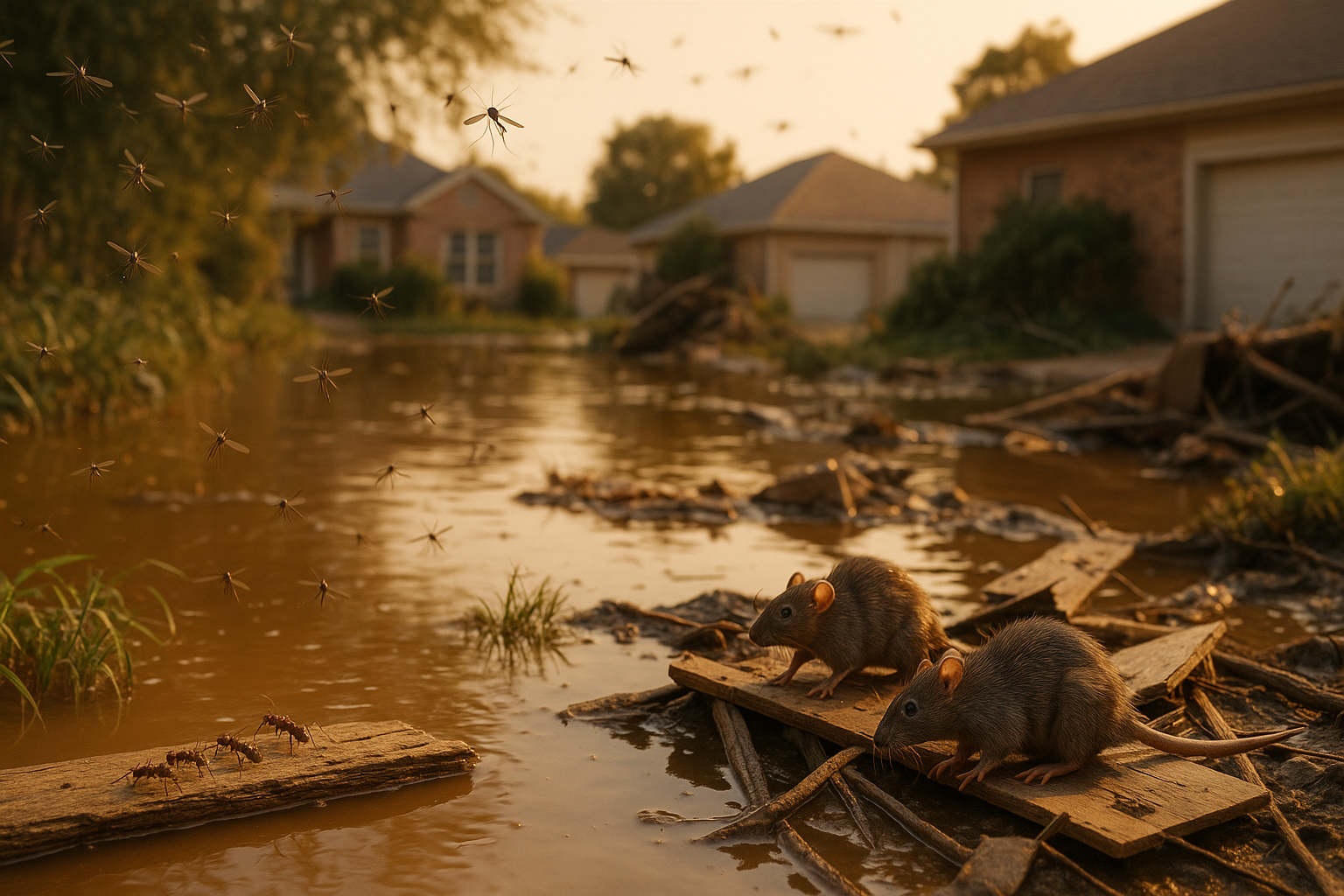
Natural disasters don’t just damage property - they also disrupt pest populations in ways that can affect homes, businesses, and public health for months. Here’s what you need to know:
- Floods and Hurricanes: Floodwaters force pests like ants and rodents into buildings. Stagnant water left behind becomes a breeding ground for mosquitoes, leading to population surges.
- Wildfires: Fires destroy insect habitats, but surviving pests often migrate to nearby homes, causing an increase in ants, spiders, and rodents.
- Droughts and Heatwaves: Limited water sources push pests to cluster near homes, increasing encounters with insects and rodents.
- Regional Impacts: Coastal areas face mosquito booms after hurricanes, while the Midwest sees shifts in ant and insect diversity after floods.
For pest control providers, understanding these trends is key to managing surges and helping communities recover. Stocking supplies, monitoring pest activity, and communicating with customers about what to expect can make responses more effective. As extreme weather events grow more frequent, preparing for pest changes is more important than ever.
Why North Carolina is seeing a bug boom after heavy rain and heat
What Drives Pest Population Changes After Disasters
Natural disasters have a way of shaking up pest populations in ways that are both dramatic and complex. By looking at the mechanisms behind these changes, we can better understand why certain pests thrive while others struggle in the aftermath.
Habitat Destruction and Pest Displacement
Disasters don’t just damage human structures - they also disrupt insect habitats. Floodwaters, for example, force ants, bees, and wasps to abandon their nests and search for dry ground. This often brings pests into closer contact with people, making them more noticeable.
Interestingly, this disruption isn’t equal across species. The invasive red imported fire ant (Solenopsis invicta) is particularly resilient, often outlasting native species that are less adaptable to sudden changes.
Other disasters like wildfires, high winds, and earthquakes can be even harsher on insect populations. Wildfires destroy vegetation and alter soil, while strong winds and seismic activity physically dismantle nests and burrows. Unlike floods or droughts - which might encourage pest migrations - these events often cause significant mortality, leaving many insects unable to relocate.
After such disturbances, generalist species that can adapt to a variety of conditions tend to dominate, as ecological diversity takes a hit. This simplified environment can throw predator-prey relationships out of balance, leading to further disruptions. Beyond physical displacement, disasters also create new environmental conditions that can pave the way for pest populations to grow unchecked.
Standing Water and Mosquito Breeding
Flooding and heavy rains bring another major concern: standing water. Every puddle, clogged drain, or water-filled container becomes a perfect breeding ground for mosquitoes. Unlike many insects that need specific habitats, mosquitoes require little more than stagnant water and warm temperatures to reproduce.
The situation can spiral quickly. Floodwaters leave behind countless small pools that may linger for weeks or even months, each acting as a mosquito nursery. This leads to rapid population surges, adding to the pest control challenges in disaster-hit areas. Essentially, the same flooding that displaces underground insects also creates ideal conditions for mosquito outbreaks, compounding the problem.
Temperature and Humidity Changes
Post-disaster environmental shifts, like changes in temperature and humidity, add another layer to the pest problem. Warmer temperatures in temperate zones can speed up pest reproduction and activity, as conditions move closer to their ideal range for growth. This is why pest issues often escalate in the weeks following a disaster, even as other aspects of the environment begin to stabilize.
In tropical areas, where temperatures are already near the upper limit for many pests, additional warming can actually slow down their growth rates. However, humidity plays a crucial role too. Increased moisture - from standing water, damaged infrastructure, or changes in vegetation - can accelerate insect development and even allow for extra breeding cycles within a season.
The ecological consequences of these changes can be striking. For instance, a study on flooding in Oklahoma found a 93% drop in overall insect abundance, a 60% reduction in species presence, and a 64% decrease in biomass nine months after the disaster. Key detritivores like isopods and millipedes - essential for breaking down dead vegetation and recycling nutrients - had not returned, leading to a buildup of organic material and a restructured food web. This shift favored species like field crickets, spiders, and beetles, which altered food availability for amphibians, mammals, reptiles, and birds. The ripple effects of these changes can disrupt entire ecosystems.
Pest Trends by Disaster Type and Region
Different types of disasters bring unique pest challenges, making it crucial for pest control providers to anticipate and prepare for these changes.
Hurricanes and Tropical Storms
Hurricanes and tropical storms hit the Gulf Coast and Southeast especially hard, often leading to a surge in pest problems. Mosquito populations, for example, tend to explode within 7–14 days after a storm. This is largely due to standing water left behind in clogged ditches, flooded yards, and damaged drainage systems. Stagnant puddles, overturned containers, and broken gutters become ideal breeding grounds. The extent of the outbreak depends on how long the water remains and the surrounding temperatures.
Rodents are another major concern. Flooded burrows and sewer systems force them to seek higher, drier ground, often driving them into partially damaged homes and commercial spaces that still provide shelter and food. Even buildings that were rodent-free before the storm might suddenly become infested.
Floodwaters also push subterranean insects above ground. These insects can be seen clustering on vegetation, floating debris, or building exteriors as they search for dry places to survive. This behavior begins with the flooding and can persist until the water recedes and repairs are completed.
Water-damaged structures present long-term pest issues as well. Wet wood, soggy insulation, and mold attract pests like carpenter ants, termites, cockroaches, and certain beetles. Structural damage - such as broken soffits, lifted roofing, and siding gaps - creates easy entry points for rodents, spiders, and crawling insects. Prolonged dampness in crawl spaces, wall voids, and under flooring can lead to infestations of wood-destroying organisms that linger for months, driving up repair and treatment costs.
Flooding presents similar challenges in both urban and rural areas, though the specifics differ.
Flooding in Urban and Rural Areas
Urban and rural areas experience floods differently, each requiring tailored pest management strategies. In urban settings, such as riverfront cities, flooding often forces pests like rats, cockroaches, and flies out of sewers and drains, making them more visible. This sudden displacement often leads to a sharp increase in human-pest encounters.
Standing water in urban areas - whether in vacant lots, clogged gutters, or damaged stormwater systems - creates ideal breeding grounds for mosquitoes, especially when the water stagnates for over a week. When floods coincide with warm summer weather, mosquito populations can spike dramatically due to accelerated larval development.
In rural and agricultural areas, the effects can be even more severe. Flooding has been shown to drastically reduce native invertebrate populations, species diversity, and biomass. For example, ground-dwelling ants, isopods, and millipedes often disappear, while more disturbance-tolerant species like crickets and spiders become more prevalent. A study in Oklahoma highlighted that out of 14 ant species present before a flood, only three remained afterward, with one being the invasive red imported fire ant, now established in at least 15 U.S. states. These changes can disrupt entire ecosystems. The absence of decomposers like isopods and millipedes, even nine months after a flood, can lead to an accumulation of dead vegetation, which then impacts food sources for amphibians, reptiles, birds, and small mammals.
These flood-related pest trends highlight the importance of monitoring specific regions, a lesson that also applies to wildfire-affected areas.
Wildfires and Post-Fire Ecosystems
Wildfires, much like floods, cause immediate pest population shifts, but their effects differ in key ways. In California and the Pacific Northwest, wildfires often lead to the direct mortality of many aboveground insects and invertebrates in burned zones. Unlike floods, which displace pests, fires often kill them outright. Detritivores like isopods and millipedes may remain scarce for months, leaving undecomposed plant material to accumulate. Initially, the pest community shifts to disturbance-tolerant species such as certain crickets, beetles, and spiders that quickly recolonize the area. Over time, as vegetation recovers, insect populations slowly rebuild but with a different species mix.
Surviving pests often relocate to unburned areas or developed regions. Homeowners and businesses near burn scars frequently report increased sightings of ants, spiders, beetles, and rodents entering their properties. This is especially common where fire or fire suppression activities have disrupted soil and vegetation near property lines. Cleanup efforts, such as removing ash and debris, can also displace ground-dwelling pests, pushing them into garages, sheds, and crawl spaces. This creates a higher demand for services like exclusion treatments, perimeter sprays, and rodent control in nearby communities.
Regional climate plays a big role in how these pest trends unfold. Warm, humid regions like the Gulf Coast and Southeast provide ideal conditions for pests to thrive after hurricanes and floods, accelerating population growth and increasing the number of generations per season. In temperate areas like the Midwest and Northeast, the timing of these disasters is critical. Floods or storms in late spring or summer can significantly boost pest growth rates as temperatures hit optimal levels for many species. Across all regions, changing weather patterns and shifting precipitation levels are expected to increase pest pressures following extreme weather events, highlighting the growing need for region-specific pest risk modeling.
sbb-itb-bfd1c41
Using Research to Improve Pest Risk Assessment
When pest patterns shift, companies can turn to disaster research to better predict, monitor, and manage pest outbreaks. By relying on measurable environmental indicators and proven monitoring techniques, businesses can shift from simply reacting to pest issues to proactively managing risks.
Signs of Increased Pest Risk
Certain environmental and structural changes often signal a higher likelihood of pest problems following a disaster. Rainfall intensity and totals are key indicators. For instance, rainfall exceeding 2 inches within 24 hours can saturate the ground, forcing ants to relocate and creating ideal mosquito breeding conditions. By comparing local weather station data with historical trends, pest control teams can pinpoint when conditions cross into high-risk territory.
Standing water is another major factor. Mosquitoes thrive in areas where water lingers for over 48 hours, such as flooded basements, clogged drains, or discarded containers. These stagnant pools quickly become breeding sites. After Hurricane Ian hit Florida, pest control companies used standing water durations to predict mosquito and ant surges, focusing their efforts on areas where water persisted and homes suffered visible damage.
Temperature and humidity spikes also play a role. When post-disaster conditions exceed 85°F and 70% humidity, insect life cycles speed up significantly. Combining these metrics with rainfall data provides a clearer picture of potential pest risks.
Structural damage and debris create opportunities for pests to invade. Broken pipes, cracked foundations, damaged vents, and storm debris piles offer entry points and shelter for rodents, ants, and cockroaches. For example, downed trees or abandoned appliances can serve as prime hiding spots. Documenting the type of damage and amount of debris during inspections helps predict which pests are likely to invade and where they might concentrate.
Pest control companies can stay ahead by combining local weather data, FEMA or NOAA flood maps, and on-site assessments. Adding historical pest data - like mosquito trap counts or rodent complaints - provides further context, enabling teams to assign risk scores and prioritize areas for service. Recognizing these signals is key to effective monitoring and response.
Post-Disaster Pest Monitoring Methods
Turning risk indicators into actionable strategies requires specific tools and structured approaches. Vector trapping, for example, helps measure mosquito populations and identify species. Using CDC light traps, gravid traps, and ovitraps in flooded areas often reveals mosquito densities two to five times higher than normal within 7–14 days after a storm. These findings help determine when treatment is necessary.
Rodent monitoring involves bait stations, snap traps, and camera traps to track activity in damaged areas. After Hurricane Katrina, rodent activity spiked in neighborhoods with compromised foundations and accumulated food waste. Monitoring tools placed near shelters, food warehouses, and residential areas provide early warnings of rodent migration into human spaces.
Insect and arthropod traps are used to track ground-dwelling pests like ants and crickets. Tools like pitfall and sticky traps reveal species presence and abundance. For instance, research following Oklahoma's 2015 flood found an overall drop in invertebrate numbers but a rise in crickets and spiders - species that adapt well to disturbances. Such monitoring helps pest control teams understand that while total insect populations may decline, certain pests can become dominant.
Geospatial tools like GIS mapping combine pest trap data with flood maps, land cover details, and damage reports to create visual risk maps. These maps highlight high-priority zones, guiding efforts like larviciding and public health alerts. Pest control companies can use similar tools to allocate resources efficiently and adjust treatment plans based on specific risks.
Community-based surveillance taps into real-time reports from mobile apps, hotlines, and customer service calls. These reports complement formal data by identifying hotspots that need immediate attention.
Together, these methods help pest control teams understand which species are surging, where they are most concentrated, and how quickly populations are recovering. This allows for a more targeted and efficient response, avoiding the need to spread resources thinly across an entire disaster zone.
Adding Pest Control to Disaster Preparedness Plans
By applying these insights, pest control companies can strengthen their disaster response strategies. Integrating pest management into emergency response plans ensures quicker and more effective action when disasters strike. For instance, pest control teams can collaborate with local emergency management and public health departments to create joint protocols. A sample plan might include conducting mosquito and rodent surveys within 72 hours of floodwaters receding, focusing on areas with standing water and structural damage.
Pre-mapped surveillance zones around key facilities allow for faster inspections and monitoring. When these zones are established in advance, response teams know exactly where to start after a disaster.
Pre-approved contracts and pre-positioned supplies also speed up deployment. Some pest control firms in Florida and Texas adopted this approach after facing supply shortages during hurricane responses. For example, after Hurricane Harvey in 2017, companies used FEMA flood maps and local health department data to pre-identify high-risk ZIP codes, deploying teams within 48–72 hours.
Clear communication protocols ensure that pest surveillance data is shared directly with emergency managers and public health officials. For example, a spike in mosquito trap counts or rodent activity in shelters should trigger alerts about potential disease risks and sanitation guidelines. Using standardized reporting tools, such as apps with photos and GPS tagging, ensures consistency and helps decision-makers act quickly.
Training first responders and emergency personnel on pest risks adds another layer of protection. Teaching them to recognize fire ant mounds in flood debris, rodent entry points in damaged buildings, or mosquito breeding sites in standing water allows the entire team to identify issues early.
Building relationships with emergency management and public health agencies before disasters occur makes it easier for pest control companies to step in when needed. These partnerships position pest management as an integral part of disaster response, helping protect public health and reducing the chances of long-term infestations.
Where More Research Is Needed
The existing body of research leaves gaps in our understanding of how pests behave after disasters, making it harder to predict and respond effectively. Filling these gaps will require focused studies, extended monitoring efforts, and stronger collaboration between scientists and pest control professionals.
Regions and Pest Species That Need More Study
Post-disaster pest research is unevenly distributed across the U.S. Coastal regions, especially the Gulf Coast and southeastern states, have been studied extensively due to their vulnerability to hurricanes and flooding. These studies have highlighted significant changes in mosquito and ant populations following floods.
However, interior regions such as the Midwest, Great Plains, and Intermountain West are underrepresented in this research. These areas face disasters like tornadoes, river floods, hailstorms, and wildfires linked to drought, yet we lack sufficient data on how these events impact pests near homes and businesses. With climate models predicting more extreme weather - like heavier rainfall and prolonged droughts - local pest control providers are left guessing when it comes to post-disaster pest surges. This lack of region-specific data makes it challenging to allocate resources, plan effectively, and work with emergency managers to address pest risks.
Additionally, while there’s been substantial focus on mosquitoes and agricultural pests, much less attention has been paid to household and structural pests such as termites, cockroaches, bed bugs, rodents, and nuisance ants. Data on invasive structural pests is especially scarce. Without detailed, location-specific research, pest control companies are forced to rely on general biological principles, which may lead to underpreparedness or missed opportunities for intervention. More precise data on these pests would allow for better service protocols, pricing, and communication with homeowners and insurers, ultimately improving disaster response strategies.
Long-Term Studies on Repeated Disasters
Most research on post-disaster pest trends focuses on short-term impacts, often just a few months. To truly understand how pest communities recover - or change - after disasters, we need long-term studies spanning years or even decades. For example, an Oklahoma flood study observed significant invertebrate losses nine months after the event but didn’t track whether or when the original pest populations recovered.
Long-term studies could help answer critical questions: Do pest communities eventually return to their original state, stabilize at a new balance, or shift toward invasive species? By combining these findings with climate projections - like expected regional temperature increases of 3–7°F and more frequent extreme weather - we can better understand how repeated disasters and broader climate trends reshape pest risks around homes, farms, and cities.
Future research should also address practical concerns for pest control and disaster planning, such as:
- How long after a flood or hurricane do indoor pests like cockroaches, rodents, or termites spike?
- Which pests are most likely to invade rebuilt structures?
- How many disaster cycles does it take for invasive species to dominate an area?
- How does pest activity align with infrastructure repair timelines?
Defining pest abundance thresholds that trigger increased service calls or health complaints would also help pest control companies manage staffing, inventory (e.g., termiticides, rodenticides, mosquito products), and community outreach during disaster recovery. Including cost estimates tied to pest trends could further aid planners in budgeting for pest management during recovery efforts.
Partnerships Between Researchers and Pest Control Companies
To bridge the gap between scientific research and practical pest management, stronger partnerships between researchers and pest control companies are essential. Pest control providers generate valuable data - such as service call trends by ZIP code, pest types, and treatment notes - that could inform research if shared in anonymized formats under data-use agreements.
When combined with local weather and disaster metrics - like rainfall, flood depth, or fire severity - this data could reveal patterns in pest behavior, helping companies adjust treatment plans and allocate resources more effectively. For example, identifying correlations between certain weather events and pest surges could allow companies to pre-position supplies and staff in high-risk areas.
Field data from pest control professionals is also crucial for developing detailed "pest risk after disaster" maps. These maps could identify neighborhoods and building types most vulnerable to pest infestations, helping prioritize surveillance and outreach efforts. For example, understanding how slab foundations, poor drainage, or proximity to standing water contribute to pest risks could improve disaster preparedness at the local level.
Collaborating with content creators who specialize in pest science and marketing can also help pest control companies translate research into actionable insights for customers. For instance, companies could create blogs, videos, or preparedness checklists that explain pest trends after disasters, such as why certain pests decline initially but rebound later or how climate conditions are expanding pest ranges. These materials not only educate homeowners and property managers but also position pest control companies as trusted partners in disaster resilience.
For pest control businesses aiming to turn research into engaging content that builds customer trust, partnering with services like Pest Control Content Marketing by Content Amplified (https://contentamplified.io) can help. By making complex scientific findings accessible and actionable, companies can strengthen customer relationships while supporting broader community preparedness.
Conclusion
Natural disasters significantly impact pest populations, often leading to increased challenges for U.S. properties. Hurricanes and floods, for example, drive ground-dwelling insects and rodents into buildings while creating standing water that becomes a breeding ground for mosquitoes for weeks. High-intensity events like wildfires and severe floods can also cause sharp declines in native insect populations, as outlined earlier. However, these disasters rarely introduce entirely new pest problems. Instead, they tend to amplify or shift existing threats, particularly around damaged infrastructure and disrupted ecosystems.
Given these shifts in pest behavior, pest control companies must turn research into actionable strategies. For instance, after storms, companies should prioritize addressing surges in mosquitoes, rodents, cockroaches, and displaced ants in affected areas. Developing disaster-specific action plans - complete with inspection checklists, treatment protocols, and follow-up schedules - can streamline responses. Stocking essential supplies like larvicides, rodenticides, and exclusion materials ahead of time, as well as adjusting staffing levels during recovery phases, ensures a more effective response. This kind of preparation not only reduces emergency calls but also strengthens a company’s reputation as a reliable partner during community recovery efforts.
Combining scientific insights with local service data - such as pest-specific call volumes, ZIP code patterns, and event timelines - alongside environmental data like flood maps and weather reports, allows companies to create detailed risk matrices. These tools can enhance decision-making around routing, marketing, and pricing strategies. Additionally, tracking metrics like callback rates, infestation levels, and treatment outcomes helps refine protocols, making future disaster responses more effective and evidence-based.
Educating customers is just as critical as treatment itself. Homeowners benefit from understanding why pest activity spikes after disasters like floods and how long these patterns might persist. Clear communication - such as explaining post-disaster pest trends and offering tailored checklists or follow-up advice - builds trust and encourages customers to follow recommended steps during stressful times.
While immediate pest responses are crucial, long-term climate trends highlight the growing need for resilient strategies. Rising temperatures accelerate pest reproduction, increase the number of generations per year, and expand their geographic ranges. There are still major gaps in understanding the long-term effects of repeated disasters and region-specific pest behaviors. Pest control firms that collaborate with research institutions - sharing anonymized service data, deploying monitoring traps, or participating in citizen-science projects - can contribute to closing these gaps while gaining access to better prediction tools and localized guidance.
Recognizing pest patterns after natural disasters isn’t just about scientific interest; it’s a vital part of preparedness and business strategy. By integrating research into disaster-specific protocols, training, inventory management, and customer outreach, pest control companies can better protect public health, minimize property damage, and create sustainable, year-round revenue streams. Firms that invest in data analysis, monitoring, and education - or collaborate with resources like Pest Control Content Marketing by Content Amplified (https://contentamplified.io) - position themselves as trusted leaders when disasters strike.
FAQs
Natural disasters, such as floods and hurricanes, can dramatically influence pest behavior, but the effects differ depending on whether the area is urban or rural. In cities, flooding often forces pests like rodents and insects to seek out dry spaces and food sources, leading to a surge in infestations. Hurricanes can make matters worse by damaging structures, creating new ways for pests to enter homes and buildings.
In rural areas, these disasters tend to disrupt natural habitats, pushing pests like mosquitoes, rodents, and other wildlife to relocate. Sometimes, this displacement drives them toward urban areas, resulting in longer-term changes in pest activity. While both urban and rural areas experience increased pest problems, cities often deal with immediate infestations, whereas rural areas may face more gradual shifts over time.
After a natural disaster, safeguarding your home from pest infestations requires a few practical steps. Begin by eliminating standing water, as stagnant water is a magnet for mosquitoes and other pests. Make sure to store food and trash in tightly sealed containers to keep rodents and insects at bay. It's also important to seal any cracks or gaps around doors, windows, and walls to prevent pests from sneaking inside.
On top of that, clear away debris like fallen branches or piles of leaves, which can become prime nesting spots for unwanted critters. Make it a habit to inspect your property regularly for signs of pests, such as droppings or visible damage, and take care of any problems as soon as they arise. Staying vigilant can go a long way in keeping your home pest-free after a disaster.
Pests such as the red imported fire ant have an uncanny ability to bounce back after natural disasters. Their resilience and resourcefulness allow them to thrive in environments that have been thrown into chaos, unlike many native species that often struggle to cope with sudden upheavals.
These invasive ants are experts at locating fresh resources, moving their colonies when necessary, and exploiting vulnerable ecosystems. This adaptability gives them a clear advantage over native wildlife in the aftermath of events like hurricanes, floods, or wildfires.