
Geo-targeted landing pages help pest control businesses attract local customers by focusing on specific locations and services. Instead of relying on a generic homepage, these pages are tailored to match search terms like "termite control in Atlanta" or "scorpion removal in Phoenix." This approach improves local SEO performance, increases conversions, and lowers advertising costs. Here's why they work:
- Higher Local Search Rankings: Geo pages target city-specific keywords, making it easier to rank in local searches.
- Better Conversions: Pages designed for specific locations address local pest problems, making them more relevant and trustworthy to users.
- Cost-Effective Advertising: By focusing on serviceable areas, geo pages reduce wasted ad spend and bring in higher-quality leads.
- Proven Results: Businesses using geo pages report up to 167% organic traffic growth and a 300% reduction in cost per lead.
These pages are designed with localized content, fast load times, mobile optimization, and trust-building elements like customer reviews and certifications. When paired with SEO and paid ad strategies, they can significantly increase lead quality and overall business growth.
@figure 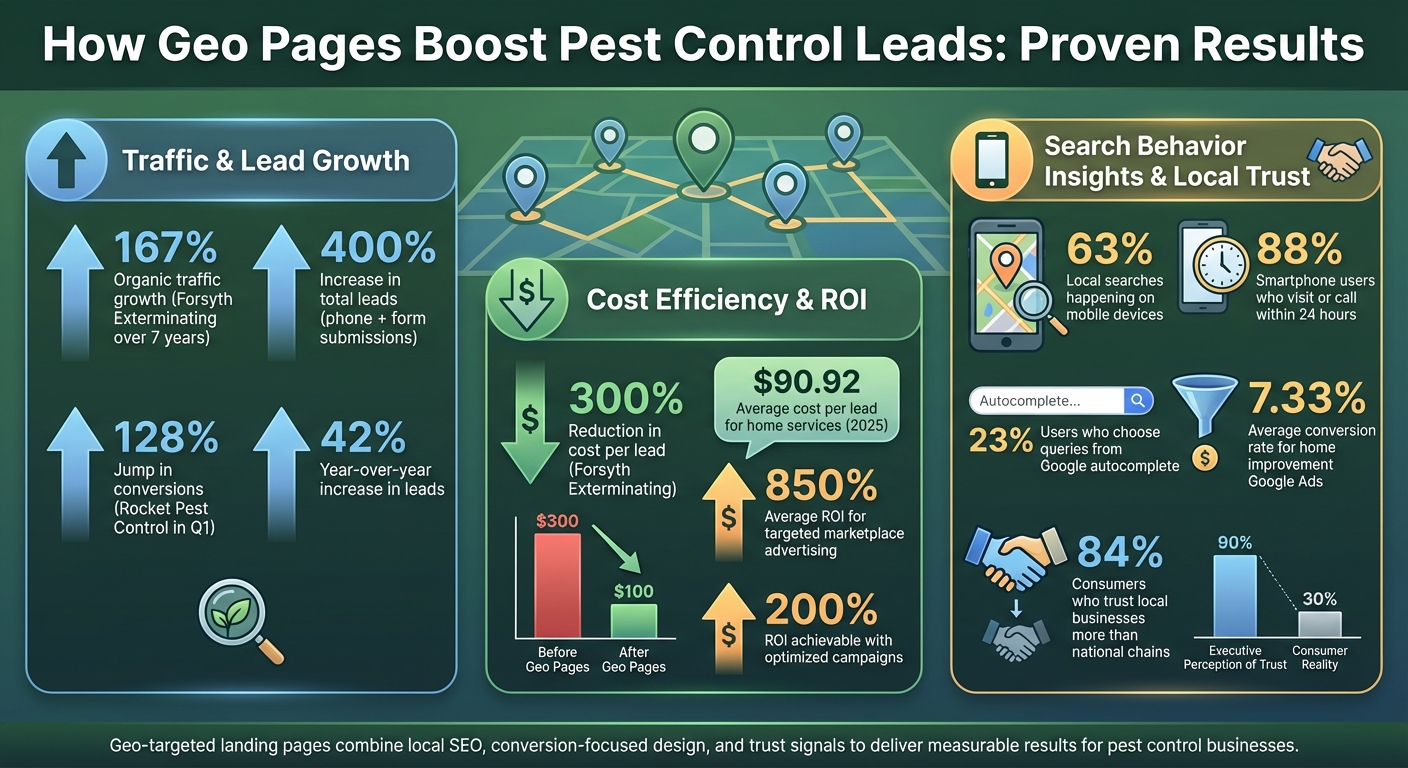 {Geo Pages Impact on Pest Control Lead Generation: Key Performance Metrics}
How Geo Pages Affect Lead Generation
Better Local SEO and Visibility
Geo pages are a game-changer for pest control businesses looking to boost their local SEO and attract more leads. By focusing on specific service areas, these pages ensure that businesses show up for highly targeted searches like "termite control in Atlanta" or "bed bug removal near me." Instead of a generic homepage appearing in search results, a well-optimized geo page tailored to a specific city or neighborhood takes the spotlight. This approach helps search engines pinpoint exactly where a pest control company operates, which is crucial for businesses that don’t rely on walk-in customers.
The results can be dramatic. Take Forsyth Exterminating, an Atlanta-based pest control company, as an example. By creating geo pages based on thorough market research and SEO-optimized content, they saw their organic traffic skyrocket by 167% over seven years. This strategy also led to over 1,000 monthly calls and a 400% increase in total leads, including both phone inquiries and form submissions.
The power of local searches is undeniable. Since December 2014, searches like "electrician near me" have surged from zero to 100 per day. A Backlinko study even revealed that 23% of users choose a query directly from Google’s autocomplete dropdown. One property management client saw immediate growth in traffic and leads after optimizing a single location for "near you" searches in December 2024. These results illustrate how geo pages not only improve visibility but also set the stage for more conversions.
Higher Conversion Rates
Driving traffic is one thing - getting those visitors to take action is another. Geo pages excel at both. Their strength lies in their ability to deliver content that resonates with local audiences. For instance, when a Phoenix resident lands on a "Scorpion Control in Phoenix" page, they’re greeted with information tailored to desert pests, Arizona-specific solutions, and local neighborhoods. This level of relevance makes it easier for users to trust the service and take the next step.
Rocket Pest Control proved the effectiveness of this approach. In October 2023, they partnered with City Ranked to implement geo-targeting strategies, including Service Area GPS Targeting. The results? A 128% jump in conversions within the first quarter and a 42% year-over-year increase in leads. Call tracking data from home services contractors further confirms that "near me" searches consistently drive high-quality leads through geo-optimized pages.
For context, the average conversion rate for home improvement businesses using Google Ads is 7.33%. However, geo pages often outperform this benchmark by delivering exactly what local searchers are looking for.
Better Lead Quality at Lower Costs
Geo pages don’t just bring in more leads - they bring in better ones. By focusing on people in serviceable areas, these pages filter out irrelevant clicks, saving businesses from wasting money on unqualified leads. This precision also slashes advertising costs. Forsyth Exterminating, for example, achieved a 300% reduction in cost per lead over seven years by combining meticulous Google Ads management with location-specific geo pages. What once was a struggle with high ad costs turned into a steady stream of high-quality leads at a fraction of the expense.
For pest control companies serving specific regions, geo pages are a cost-effective alternative to broad marketing efforts. While the average cost per lead for home services businesses in 2025 sits at $90.92, with a typical year-over-year increase of 10.51%, companies leveraging geo pages can buck this trend. By targeting qualified local leads who are already ready to book a service, they reduce costs and maximize efficiency. Geo pages don’t just drive clicks - they drive results.
Key Features of High-Performing Geo Pages
Localized Content and Keywords
Every geo page should zero in on a single service and a specific location, featuring content tailored to that area. The content needs to clearly explain how your business meets the unique needs of the local community, addressing specific pest problems and preferences.
NAP consistency - your Name, Address, and Phone number - must be uniform across your website, Google Business Profile, and any directory listings. Consistency in these details strengthens your local credibility. Adding images of your team, service vehicles, or recognizable landmarks not only reinforces your presence in the area but also helps search engines better understand your service coverage.
Incorporating city names, neighborhood references, and ZIP codes naturally into your content is key. These should appear in titles, headers, and service descriptions. For example, a homeowner in Mesa searching for "scorpion control" is more likely to engage with a page that specifically mentions Mesa instead of a generic reference to Arizona.
This level of personalization sets the stage for a design that encourages visitor action.
Conversion-Focused Design
The primary goal of geo pages is to turn visitors into leads. With more than 60% of Google searches happening on mobile devices, your geo pages must be optimized for smartphones. This means using responsive design, larger fonts, and touch-friendly buttons.
Page speed is another critical factor.
Chad J. Treadway, Partner and Chief Smarketing Officer at Cube Creative, emphasizes that "a faster-loading page improves user experience and positively impacts your search engine rankings, as page speed is a key ranking factor".
If your page takes more than a few seconds to load, visitors may leave for a competitor. To prevent this, compress images, reduce HTTP requests, and enable browser caching to ensure smooth performance.
Adding click-to-call buttons makes it effortless for users to contact you with just one tap, increasing the likelihood of conversions. Combine this with short, straightforward contact forms that only ask for essentials - like name, phone number, and service needed - and position these forms prominently above the fold or near your main call-to-action.
LinkNow Media explains, "this has been shown to increase conversions by making it simple for users to take action right when they're interested".
A well-thought-out design, combined with trust-building elements, creates a winning geo page.
Trust Signals and Customer Testimonials
In pest control, trust is everything. Customers are inviting you into their homes and relying on you to handle potentially hazardous treatments. Yet, there’s often a gap between how much businesses think they’re trusted and how customers actually feel - 90% of executives believe their companies are highly trusted, but only 30% of consumers agree. Geo pages should work to close this gap fast.
Local customer testimonials are a great way to build trust. Research shows that 84% of consumers trust local businesses more than national chains. Highlight reviews from neighbors in the same city or ZIP code to boost credibility. Prominently display Google Business Profile reviews and ratings from platforms like HomeAdvisor, Angi, BBB, or Nextdoor. Adding video testimonials and before-and-after photos can make your page even more compelling.
Showcasing your licenses, certifications, and guarantees adds another layer of trust. For instance, display your QualityPro certification, state pest control license, or any local awards directly on your geo pages. Responding to all reviews - positive or negative - within 24 hours also demonstrates your professionalism.
Cameron Bawden, CEO of Green Mango Pest Control, shares: "Our touch and feel with the customer, whether that's the truck, the marketing packet, the uniform the technician wears, we'll never sacrifice on that because that's the experience that the customer remembers and wants to be a part of".
When potential customers see this level of dedication, they’re far more likely to pick up the phone and call.
Case Studies: Geo Pages in Action
SEO Success with Multi-Area Pages
Service area businesses that leverage geo-targeted pages often experience a noticeable boost in local search visibility. For instance, pest control companies can create dedicated pages for each city, neighborhood, or ZIP code they serve. This approach allows them to rank for location-specific terms like "termite control in [City A]", "bed bug treatment in [City B]", and "rodent removal in [City C]" - all without competing for broader, less targeted statewide keywords.
Why does this work? Search engines favor businesses that clearly demonstrate relevance to specific locations. By tailoring content to individual areas, companies align with what users are searching for, especially on mobile devices. In fact, 63% of local searches happen on mobile, where users are often looking for immediate solutions.
However, success depends on more than just swapping out city names on a template. Search engines penalize "doorway pages" that add no real value. To avoid this, businesses must create unique, locally relevant content for each page. This might include addressing specific pest issues common to the area, referencing local landmarks, or highlighting community involvement. These details not only improve SEO but also build trust with potential customers.
By strengthening local SEO, these geo pages also set the stage for better performance in paid campaigns.
PPC Campaign Results with Geo Pages
Geo-targeted landing pages aren’t just great for SEO - they also drive better results for paid campaigns. When ad copy aligns with the content of geo pages, businesses see higher click-through rates, improved conversions, and reduced ad costs.
Take, for example, a homeowner in Phoenix searching for "scorpion control near me." A landing page that specifically addresses scorpion control in Phoenix directly matches their search intent. This alignment improves Google's Quality Score, which can lead to better ad placements and lower cost per click.
Geo-targeted PPC campaigns are designed to focus ad spend on consumers actively searching for local services, ensuring every dollar is well spent. For pest control companies, the return on investment speaks volumes: the average ROI for targeted marketplace advertising reaches 850%, with some campaigns achieving up to a 200% ROI. Even more striking, 88% of smartphone users who search for local services either visit or call a business within 24 hours. This highlights the combined power of mobile-optimized geo pages and location-specific ads in generating immediate leads and driving conversions.
sbb-itb-bfd1c41
Practical Takeaways for Pest Control Businesses
Benefits of Implementing Geo Pages
Geo-targeted landing pages are a game-changer for pest control businesses operating in multiple cities. These pages are designed to attract local customers searching for services like "termite control in [City]" or "bed bug treatment near me." By focusing on specific locations, geo pages help you connect with people who are actively looking for your services, making it easier to turn visitors into paying customers. Plus, they’re cost-effective, offering measurable returns on investment without requiring a hefty marketing budget. Another advantage? They allow you to rank for location-specific keywords, reducing competition with businesses outside your service area. This targeted approach ensures your marketing efforts are directed where they matter most.
How to Measure Success
To know if your geo pages are delivering results, you need to track the right data. Start with Google Analytics to monitor organic sessions and unique visitors for each page. Keep an eye on conversion rates by measuring actions like contact form submissions, phone calls, or appointment bookings. If you're running paid campaigns, calculate the cost per lead (CPL) for each area to identify where you're getting the best return. Don’t forget to check your Google Business Profile metrics, such as views, website clicks, and direct calls, to gauge local engagement. Tools like Semrush Position Tracking or BrightLocal can also help you see how well your geo pages rank for local keywords relevant to your services.
"Set clear, measurable goals for your local landing page optimization efforts, such as increasing organic traffic, improving conversion rates, or reducing cost per lead."
- Cube Creative
With these metrics in place, you’ll have a clear picture of what’s working and where there’s room for improvement.
Working with Marketing Experts
If you’re serious about growing your local presence, collaborating with marketing experts can take your geo strategy to the next level. Each geo page should feature unique content tailored to address specific pest problems in that area. Simply swapping out city names on a template won’t cut it. This level of customization often requires skills that aren’t always available in-house. By partnering with specialists like Pest Control Content Marketing by Content Amplified, you gain access to professionals who understand both SEO best practices and the specific needs of the pest control industry. Their services include creating SEO-focused content, designing mobile-friendly websites, and promoting your business strategically. These efforts are all aimed at helping pest control companies grow their service areas, attract more leads, and improve their overall SEO performance.
Pest Control SEO Case Study | Rank #1 in Your Local Area | Alex Meyerhans
Conclusion
Geo-targeted landing pages are a powerful way to improve local SEO and stand out in Google's map pack. This means homeowners can easily find your pest control services when they need help the most - right when pest problems strike.
But it’s not just about being seen; these pages also help you connect with your audience. By addressing local pest concerns and using personalized content, geo pages attract the right kind of traffic - people ready to take action. This can lead to higher engagement and more conversions.
However, generic content won’t cut it. Each geo page needs to be crafted with care, featuring locally relevant content, targeted keywords, and testimonials from nearby customers. This approach not only builds trust but also makes your pages more effective at solving specific pest issues for your community.
FAQs
Geo-targeted pages are a smart way for pest control businesses to connect with local customers by creating landing pages specifically designed for individual service areas. These pages use local keywords and area-relevant content, helping search engines pinpoint their geographic focus and rank them higher in local search results.
By catering to the specific needs and concerns of customers in each area, these pages do more than just improve visibility. They also build trust and encourage engagement, which naturally leads to more inquiries and a steady flow of new leads for pest control businesses.
Geo-targeted landing pages are crafted to connect with local customers by focusing on specific areas like cities, neighborhoods, or ZIP codes. These pages incorporate location-specific keywords in the headline, meta tags, and throughout the content to rank better in local search results. For instance, phrases like "pest control in Dallas, TX" help capture searches from people looking for services in that area. Including details like local landmarks, climate-related pest issues, or region-specific visuals makes the content feel more relatable and trustworthy to potential customers.
To boost conversions, the page should include a strong call-to-action (e.g., "Call (555) 123-4567 today") along with essential local details like a phone number, address, and an embedded Google Map. Adding local social proof, such as reviews or testimonials from nearby clients, can further enhance credibility. Additionally, making sure the page is mobile-responsive, quick to load, and optimized with structured data improves both search rankings and the overall user experience.
For pest control companies, these tactics lead to better visibility in searches like "pest control near me" and attract more qualified leads. Pest Control Content Marketing by Content Amplified specializes in creating geo-targeted pages designed to deliver results and maximize ROI for every service area.
To gauge how well your geo-targeted pages are performing, focus on tracking key metrics like website traffic, keyword rankings, form submissions, phone calls, and conversion rates. It’s also important to look at the total number of leads generated and calculate your cost-per-lead to evaluate ROI. These metrics provide a clear picture of how effectively your geo pages are engaging local customers and contributing to your business growth.